
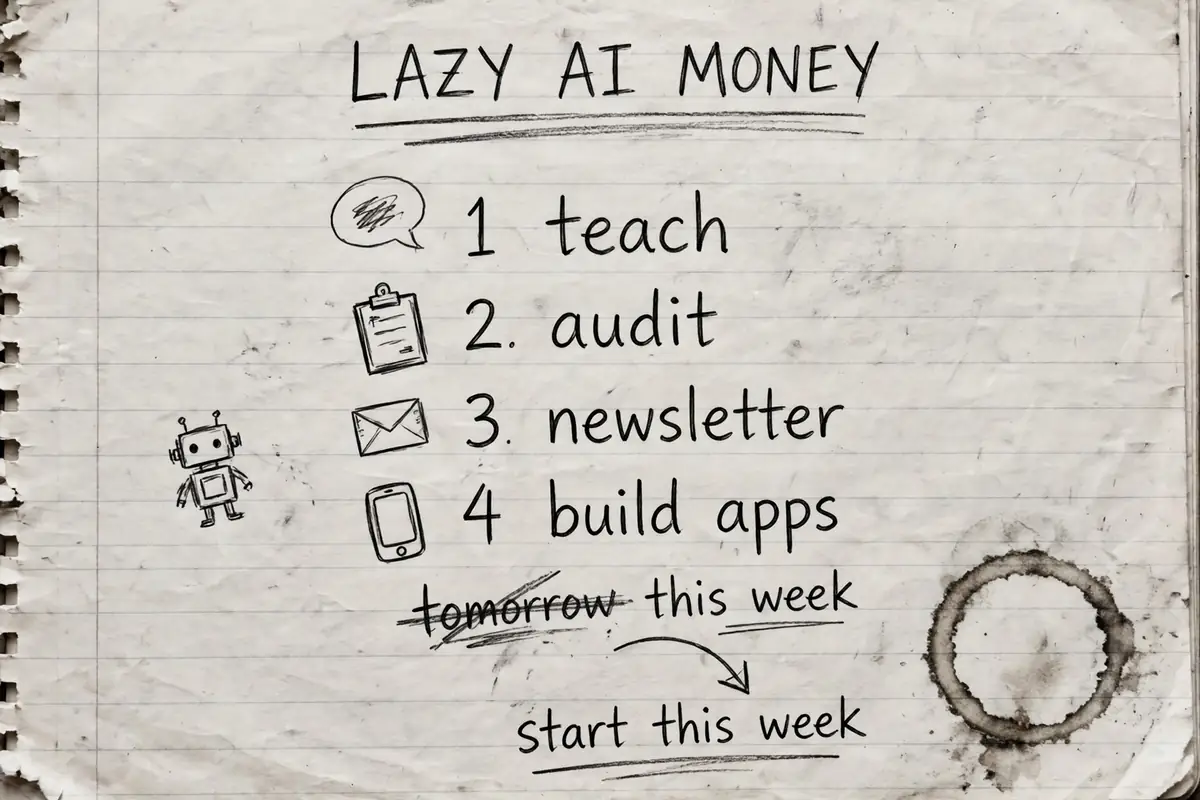
Most people hear “make money with AI” and picture a prompt pack, a faceless channel, or some tool doing everything while they sleep. The laziest ways to make money with AI that hold up in practice look different. They are mostly ordinary work with the slow parts handed to AI: teaching, auditing, writing a newsletter, building a small app.
The four methods below come from a walkthrough by Eliot Prince, who says he spent years doing SEO work before switching his income over to AI in about four months. His list is ranked by how much of you it needs. The first method can start this week with skills you already have. The last one asks for months and some money, and he is upfront about that.
Method 1: Teach people to use AI, one at a time
This is the fastest route to a first payment, and the entry bar is lower than most people assume. You do not need to be a top-level expert. You need to be roughly one level above the person in front of you. If you are a five out of ten with AI tools, you can teach someone who is a two. If you are a three, you can teach someone who has never opened ChatGPT, which describes most people. One figure quoted in the video puts paid AI accounts at about 0.3% of the world’s population. The average business owner is paying for help with things like writing a decent prompt, setting up a Claude or ChatGPT project, or building a custom GPT. Prince charges $100 an hour for exactly this, and his first paying student was his own business mentor.
Where the first students come from
Skip the ads and the cold emails. Start with your phone book. There is a decent chance someone you already know has said they want to learn this stuff and never got started. After that, go to local networking events: chamber of commerce meetups, founder mixers, business breakfasts. Finding them is a job you can hand to AI itself. A deep research prompt in Perplexity, Claude or ChatGPT, pointed at your town, will return a list of events for the next 30 days. At the event you say one sentence about what you do: you help people get started with AI. The questions come to you, because nearly every owner there knows they are behind and finds the tools overwhelming. The session itself is one or two hours, in person or on a call, tailored to their business, so they leave with prompts and a project setup they can actually use.
Method 2: Run AI audits for local businesses
Method two sells the same knowledge at a higher price, and the door-opener is free. You offer a local business a free AI audit: half a day spent watching how they work, asking diagnostic questions, and finding where time and money leak out of the week. A plumber’s office, a small logistics firm, a clinic. The workflows differ, the leaks rhyme: slow replies to customers, manual admin, reports nobody enjoys building.
How the audit works
You do not need to invent the questions. Prince feeds a prompt into Claude with three facts about the business (what it does, its industry, its team size) and gets back a tailored questionnaire. His test run on a 20-person food delivery company produced 44 questions in about an hour’s worth of auditing time, grouped by area: delivery routes, customer communication, admin, finance. Record the session if they agree, then hand the notes to a second prompt that turns findings into recommendations, and use a tool like Gamma to dress them up as a short presentation.
The sale happens in that presentation. Once an owner has seen, in writing, how many hours a week leak away and what fixing two or three of them is worth, the paid work sells itself: set up the customer service GPT, build the marketing project, write the prompt library. Prince says he moved from free audits to charging $3,000 and more for the audit alone. If a recommendation is too technical for you, partner with someone who can build it and split the revenue. You did the finding and the selling. They do the wiring.
Method 3: Start a local newsletter that AI helps you write
This is the quiet one, and the closest thing on the list to passive. Pick your town or city. A deep research prompt, run once a week, gathers what is happening locally over the next 30 days: festivals, markets, gigs, free events, new openings. A second prompt turns that raw report into a newsletter draft, written in a custom style you set inside Claude so it sounds like a person from the area, not a press release. Prince reckons each issue takes him under half an hour, including the human pass at the end.
Subscribers first, money second
His first 110 subscribers came from one afternoon of messaging people he already knew in the area. Local Facebook groups and community boards came next, plus a simple offer to event organisers: want your event featured? Small ad budgets work here too, around $5 a day on Meta ads aimed at a tight local radius. The money arrives once the list is worth something to local businesses, which he puts at roughly 1,000 subscribers. At that point a cafe or a venue will pay, starting around $50, to sit at the top of the newsletter or get their event featured. Take that $50, put it back into ads, and the list grows faster. It is a slow flywheel, but it turns while you do other things, and it stacks small payments from several local businesses in much the same way bigger platforms stack income, a pattern worth comparing with how Amazon makes money across its many separate streams.

Method 4: Build small AI apps that solve one annoying problem
The last method has the highest ceiling and the worst odds, and the video says so plainly. Tools like Replit, Lovable and Bolt will build a working web app from a plain-language description, so the building is no longer the hard part. Finding something people want is. Most people skip that step, build an idea nobody asked for, and then discover marketing is the expensive bit.
Find the problem before you build anything
Two hunting grounds work. The first is Reddit. A deep research prompt can mine a subreddit in your chosen niche for repeated complaints and turn them into a shortlist of pains that would be simple to fix with a small tool. His example run on parenting produced ideas like a school communication hub, a meal planner for picky eaters, and a chore tracker for overwhelmed families. The second hunting ground is search demand itself: a tool called Build The Keyword surfaces phrases people search for in real volume where almost nothing decent exists yet. Prince used that route himself and built a small app that generates bucket list ideas, because people kept searching for them and finding thin pages. An app like that earns in ordinary ways: affiliate links to booking sites, a bit of advertising, or a paywall after a handful of free uses. Expect a few attempts before one lands. What you keep from the failed ones is skill at the process.

The laziest ways to make money with AI: which one is actually laziest?
If lazy means soonest money for least setup, it is method one, teaching. There is no product to build, no audience to grow, no ad account to feed. You need to be one level above a beginner, own a phone book, and show up where business owners gather. The audits in method two pay more per client but ask you to sell. The newsletter and the apps are where the income starts to detach from your hours, and both take months to matter. None of these is a route around work, and they will not add up to how to make your first million on their own. They are better understood as a first rung: cash in quickly with teaching, then put some of it into the slower assets while the skills compound.
Disclaimer: This article is educational content based on a public video. It is not financial advice, and it does not promise any income or result. Earnings mentioned are one person’s reported figures; yours will depend on your work, your market, and your circumstances.