
Buy a $30 item on Amazon and almost none of the interesting money sits in the item. Amazon probably did not make it, and usually never owned it either. A third-party seller did, and that seller is about to hand Amazon roughly $13 of your $30 for being found by you.
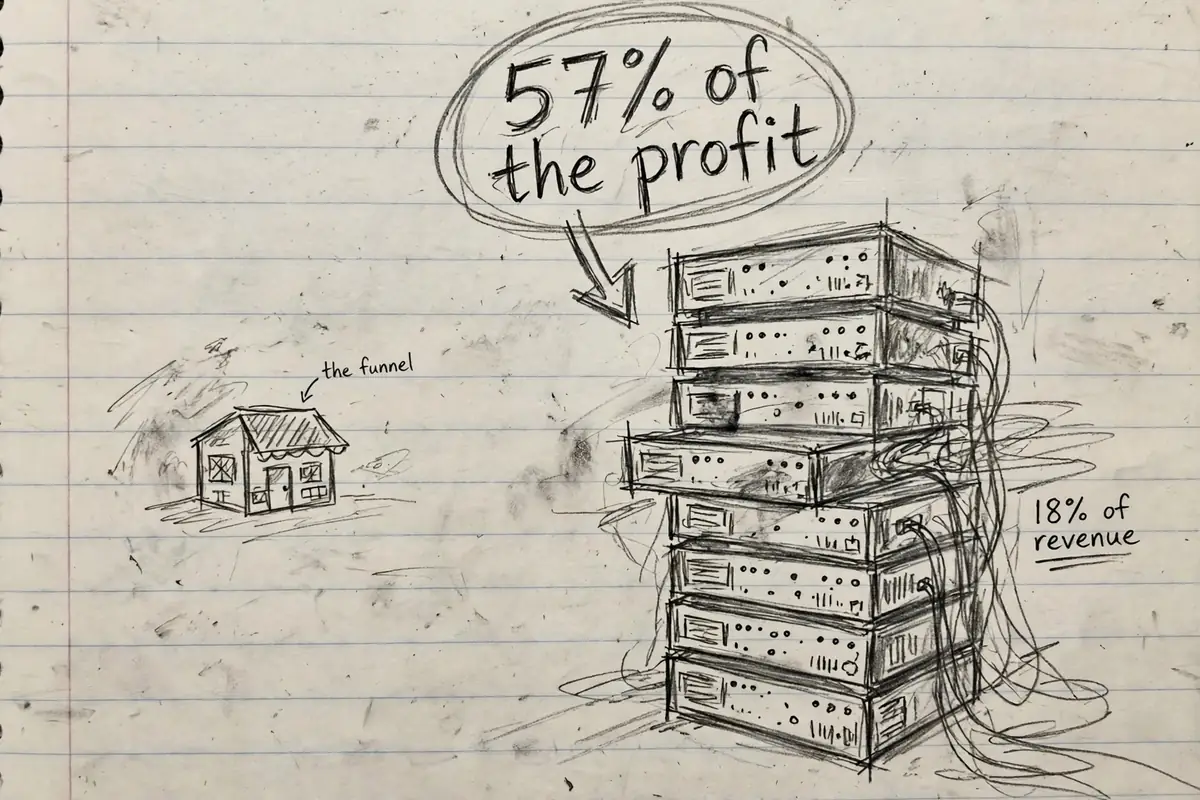
Zoom out and the pattern holds at full scale. Last year Amazon took in $717 billion in revenue and turned $80 billion of it into operating profit. So how does Amazon make money, if the shop is not where the profit sits? Split the company in two and 57 percent of that profit sits in a division that sells no products at all.
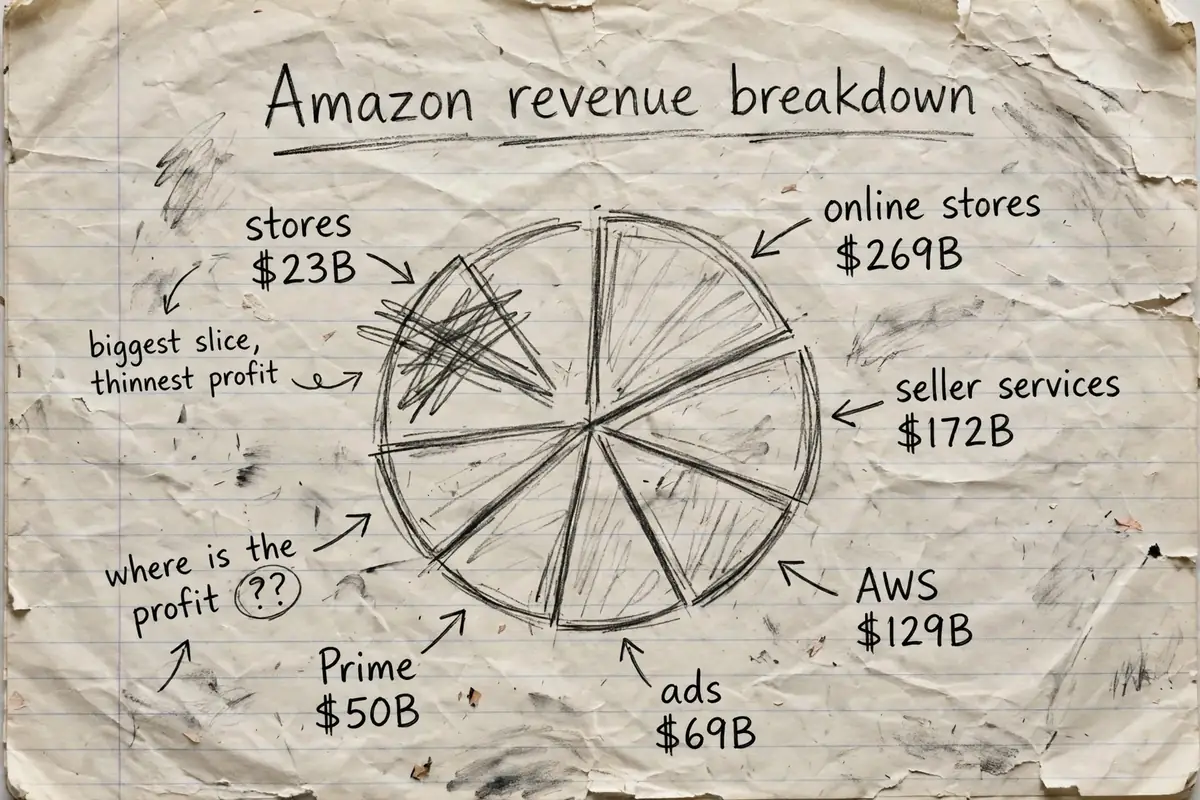
How does Amazon make money? The seven revenue lines
Amazon reports income in lines that behave like companies: online stores $269 billion, third-party seller services $172 billion, AWS $129 billion, advertising $69 billion, subscriptions $50 billion, physical stores $23 billion. The largest line, the shop itself, is nearly the worst business in the pile.
The shop itself runs close to break even
The online stores line is Amazon acting as an ordinary retailer, and retail margins on that kind of merchandise sit in the low double digits before warehouse, van, driver and return costs. Across North America and international retail, $588 billion of sales produced $34 billion of operating income last year.
That thin result is deliberate. Retail is a machine for producing traffic, and traffic is the raw material the profitable businesses upstairs are built from. The private labels work the same way: Amazon watches the sales speed and review pattern of everything on its shelves, then aims its 30 or so house brands, Amazon Basics and Amazon Essentials among them, at large, boring categories owned by nobody in particular, and undercuts the brand. Returns drag the numbers down further, since collecting and relisting a return often costs more than the item is worth.
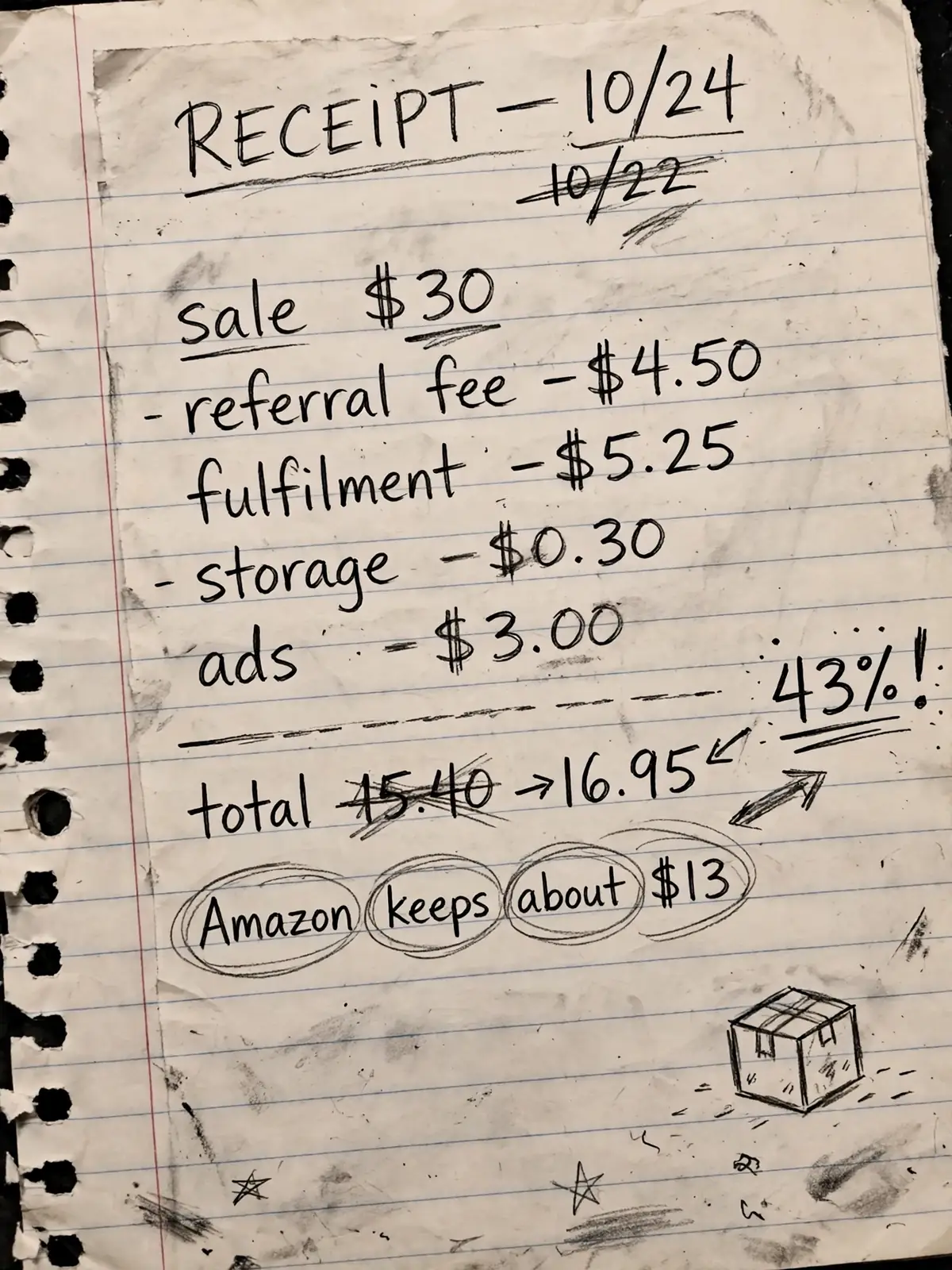
How much does Amazon keep from a $30 sale?
About 61 percent of everything sold on Amazon comes from independent sellers using the site as a shopfront. Amazon counts only what it charges them, and last year those charges came to $172 billion.
The referral fee comes off first
Amazon takes a percentage of the sale price for the transaction happening on its site. Depending on the category, that referral fee runs from 8 percent to 45 percent. For most physical goods it is 15 percent. On $30, that is $4.50 gone before the seller has shipped a thing.
Fulfilment, storage and the ad bill
Most sellers use Fulfilment by Amazon: they ship stock in, and Amazon picks, packs, delivers and handles returns, at roughly $5.25 per unit. Storage runs $0.87 per cubic foot most of the year and $2.40 in the fourth quarter, near 30 cents on our item. Then advertising. Sellers commonly spend around 10 percent of revenue on Amazon ads to stay visible, so call it $3.
Add it up and Amazon ends with about $13 of the $30, roughly 43 percent, before the seller has paid for the product itself. The seller bought that item for $9 landed and keeps $7.95, around 26 percent, with staff, software, overhead and tax still to come out of it. Anyone trying to build their first million from an online business hits this wall early. The platform takes its cut whether you profit or not.
The Buy Box decides who actually gets paid
Sellers offering the same product share one listing, and only one of them sits in the Buy Box at any moment. Roughly nine out of ten purchases go to whoever holds it. Amazon picks the winner on price, delivery speed, seller performance and stock reliability, and using Amazon’s own fulfilment is one of the strongest ways to win. So a seller who skips FBA to save $5.25 a unit becomes slower, loses the box, and loses the sale entirely. An optional service becomes compulsory without anyone making it compulsory.
Why do sellers accept this? Roughly two thirds of American online product searches begin on Amazon rather than Google, so leaving means leaving the water. The Federal Trade Commission and 18 state attorneys general are suing over exactly this structure, in a case scheduled for trial in March 2027, and the number at the centre of the argument is the one above. $13 out of $30.
Advertising rents out the top of the search results
Advertising brought in $69 billion last year and grew 26 percent in the most recent quarter. That makes it Amazon’s third largest revenue line, one of the biggest advertising businesses on Earth, and the most profitable retail line by a distance.
Search for a coffee grinder and the first results are frequently not the best coffee grinders. They are the ones whose sellers bid the most. Two things make those slots so valuable. The first is intent: Amazon catches you inside a shop, card saved, one click from owning the thing. The second is measurement. Amazon owns the ad and the checkout, so it can tell advertisers how many viewers bought.
An impression also costs almost nothing to serve. Businesses of this type run margins well above 50 percent, and Amazon takes around 69 percent of every dollar spent on retail media advertising in the United States. Walmart, in second place, holds less than a tenth of that share.
Prime is a $50 billion habit machine
Subscriptions brought in $50 billion, and more than 200 million people pay for Prime at $139 a year or $14.99 a month in the US. Survey data cited in the source puts member spending at roughly twice non-member spending, around $1,100 a year against $600.
Once you have prepaid $139, buying somewhere else feels like waste, and shipping that once felt like a cost now feels free. It is not free. You paid in January. Everything bundled in serves one purpose: a membership holding a half-finished series is a membership that renews. In September 2025 Amazon also agreed to a $2.5 billion FTC settlement over Prime enrollment and how hard it was to leave.
AWS quietly pays for almost everything
Amazon Web Services took $129 billion last year, 18 percent of total revenue, and produced $45.6 billion of operating income, 57 percent of the company’s profit, at a 39 percent margin. It grew 37 percent last quarter, its fastest pace in four years. AWS out-earned all of Amazon’s retail put together, on a fifth of the sales.
The popular story says AWS began as spare server capacity left over between Christmases. The people who built it say that is not what happened. Amazon’s internal systems had grown so tangled that teams spent months rebuilding the same storage and database plumbing before starting anything new, so it rebuilt that plumbing as clean, documented services, noticed every other company had the same mess, and started selling it in 2006.
The economics are close to ideal. A data centre costs a fortune to build once, and each extra customer costs a fraction of that. Customers almost never leave, because moving a company’s whole infrastructure is a multi-year project that can break the business mid-move. A meaningful share of the internet runs on Amazon servers. The AI buildout has poured fuel on it: Amazon says its AI business and its custom chip business have each passed a $25 billion annual run rate, and capital spending is guided at $220 billion.
The side businesses most people never add up
Delivery is the accident that became a business. Amazon built its own logistics network because existing carriers could not serve the Prime promise, and last year that network delivered an estimated 6.7 billion US parcels, more than the postal service, more than UPS, roughly double FedEx. Amazon sells access to it through FBA, Buy with Prime and Amazon Shipping, while automation cuts the cost per package: 1 million robots across more than 300 facilities in 2025, against a warehouse workforce of 1.2 million.
The rest of the pile would be headline businesses anywhere else. Echo speakers, Kindles and Fire tablets sell at or below cost, because a Kindle sold at cost is a person who now buys books from Amazon, and an Echo in the kitchen is a reordering device with a speaker attached. Physical stores took $23 billion, mostly Whole Foods, bought for nearly $14 billion in 2017, in the one category where its advantages have translated awkwardly.
So where does the money actually sit?
Retail builds habit. Habit produces sellers who must pay to be seen, locked-in shoppers, and the order volume that justifies a logistics network rented back out. Amazon is, at the same time, the landlord, the referee and one of the players. That also explains 20 years of barely reported profit: the profit was available, and it was spent on warehouses, servers and delivery capacity instead.
What could break it? A court could cap the take rate, sellers could hit their fee ceiling now that TikTok Shop, Walmart and Temu exist, and AI assistants could take the front door and compare the whole internet without loyalty to anyone. None of that changes where the money sits today. The shop was never where the money was. The money is in the fees, the auction, the subscription and the rented computers, and the shop exists to feed all four.
Disclaimer: This article is educational content about how a public company earns money. It is not financial or business advice, and it promises no result of any kind.