Some of the hardest workers you know are probably stuck. They put in more hours than everyone around them, and their income barely moves. The gap is rarely effort. It is leverage: the ability to make a small action keep producing results after you stop.
Leonardo da Vinci started with no family name, no money, and no patron. Napoleon Hill spent about 20 years studying people who had built fortunes from empty pockets. Two different centuries, same conclusion. You do not need capital first. You need to learn how to build leverage out of what is already in your hands: attention, skills, and a few other people.
This post pulls their approach into one system: three laws of leverage, a six step playbook that runs for 90 days, and the failure modes that quietly wreck the whole thing.
What leverage means, in plain terms
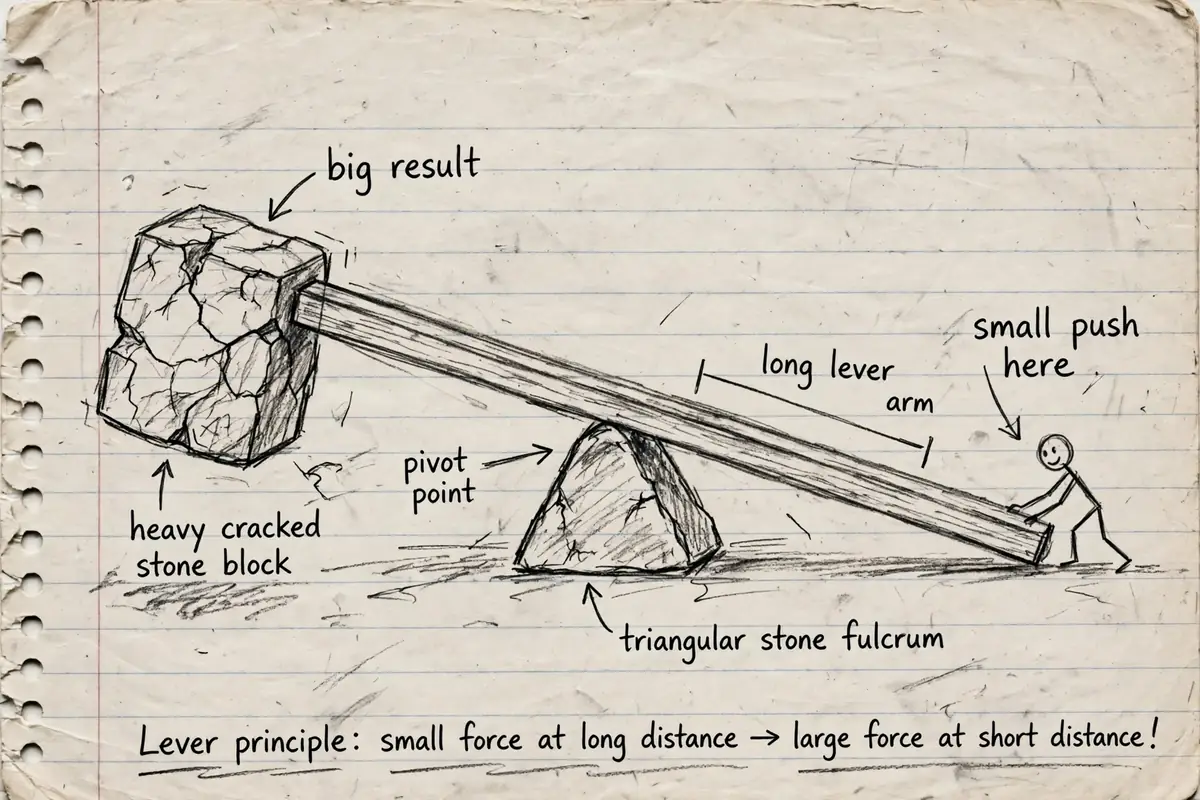
Leverage means using a small input to create a result that keeps working without you. A worker sells hours, and the money stops when he stops. A builder makes something once, and it keeps paying him back.
There are four kinds of leverage: information, systems, people, and capital. Most people chase capital first, as if it were the first domino. In this framework it is the last one to fall. Information, systems, and people come first, and all three are open to someone with no money at all.
Law one: observation comes before everything
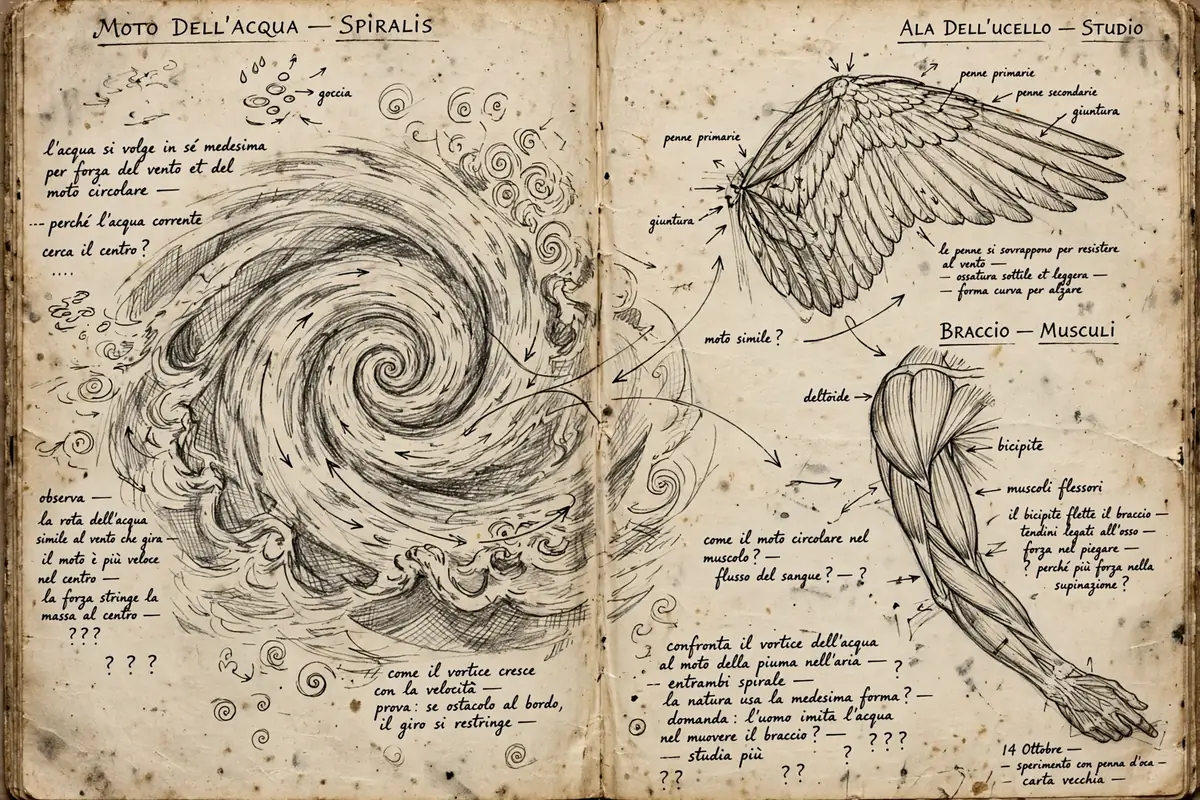
Da Vinci could not buy influence. What he had was patience and a pair of eyes. He watched water twist through a stream and noticed the same spiral shape inside the muscles of a human arm. He studied birds until their rhythm showed up in his sketches for flying machines. Again and again, he connected things nobody thought belonged together: art with anatomy, anatomy with mechanics.
His real habit was simpler than genius. He wrote it all down. Observation in a notebook becomes property, pages of stored patterns you can trade later for an invention, a design, or a reputation. His journals were his first asset, built at the cost of attention alone.
The practice version is plain. Spend time each day noticing instead of scrolling. Write down what repeats, what breaks, and what stands out, then ask where else the same pattern could create value. It costs nothing, and it compounds.
Law two: a definite purpose aims the effort
Hill studied achievers who began with empty pockets, and he kept finding the same trait: one goal clear enough to cut through distraction. They did not wish for outcomes. They designed them, then organized their days around the design.
His method was autosuggestion. Write one statement of purpose. Read it out loud every morning and every night, until the words start directing your behavior on their own. Modern psychology calls a similar idea cognitive priming. The label matters less than the effect: a mind with a fixed target spots relevant chances faster and wastes less on the rest.
Motivation is unreliable. Direction is not.
Law three: artifacts and a mastermind do the multiplying
An artifact is anything that carries your intelligence while you are absent: a guide, a design, a video, a process written down. Once it exists, it works while you rest.
The mastermind is the social side. It is not a crowd and not a fan club, just a small circle of disciplined people who sharpen each other. Da Vinci had apprentices who questioned his drawings. Hill built alliances of entrepreneurs who traded strategy instead of gossip. Three people pulling toward one outcome will outperform thirty people sharing opinions.
Together the sequence is clear. Observation finds the patterns. Purpose aims the energy. Artifacts and people multiply the result.
The 90 day playbook: how to build leverage in six steps
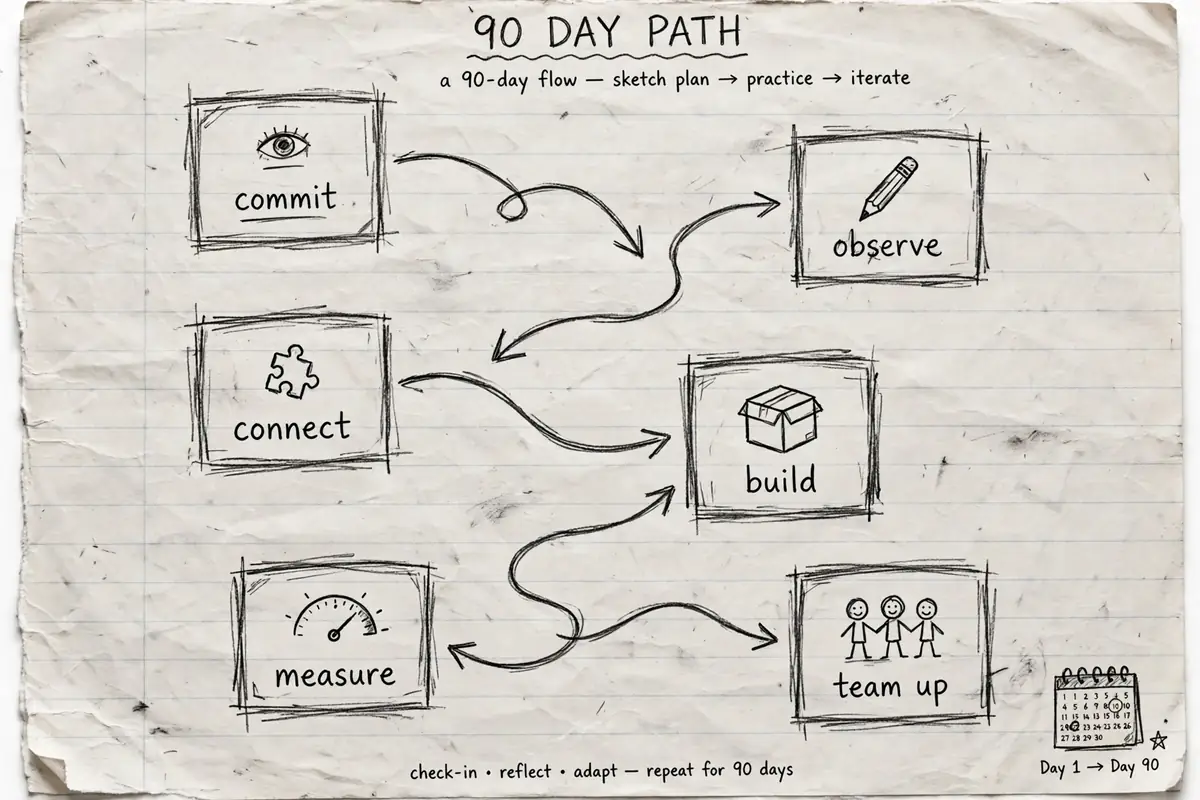
The framework turns into a 90 day plan. Every step is small, concrete, and free. You need a notebook and consistency, nothing else.
Step 1: Commit to one outcome, in writing
Write a single sentence: by a fixed date, you will build one system or artifact that produces value you can measure. Put the date on your calendar. Read the sentence every morning and every night. Attention, not time, is your real currency.
Step 2: Keep an observation journal for 14 days
Each day, write three things you noticed, at work, on the street, anywhere. Every note answers three questions. What is happening? What makes it unusual? Where else could this pattern apply? After two weeks, pick the three patterns that feel most alive.
Step 3: Connect a skill you have to a pattern you found
Everyone owns at least one usable skill, even if they have never named it: writing, explaining, fixing, organizing, listening. Write one line that names yours: the skill you will use, the problem it solves, and the pattern it rides on. That line is your prototype in words.
Step 4: Ship a rough artifact within 7 days
Build the first version fast, something you can finish in about 72 hours: an article, a short video, a simple tool. Da Vinci filled pages with unfinished ideas because moving reveals problems faster than reflecting does. Publish it. One artifact in the world beats a thousand plans in a drawer.
Step 5: Measure three numbers
Post the artifact where people can react, then watch reach, retention, and response: how many saw it, how long they stayed, and what they did next. If the signal is weak, change one variable at a time, the title, the form, or the delivery, and leave the core idea alone until you know why it failed.
Step 6: Add people, then write the system down
Form a micro mastermind of three: one who creates, one who executes, one who distributes. Each person owes one deliverable every two weeks, and each shares the group’s work through their own network. Then document what works as repeatable steps, and automate one link in the chain, by scheduling output or batching the work. By day 90, the target is three assets: a written system, a working artifact, and a small circle.
Four small examples, same pattern
An artist with a day job painted at night. For one month he sketched scenes from city life every morning and watched which ones people reacted to. Drawings with motion, a cyclist in the rain, a child running, pulled the strongest response. He printed ten sketches into a booklet and sold it for $5. Buyers asked for prints, and the notebook began earning while he slept.
A writer, a designer, and a teacher met in an online forum, none with an audience worth mentioning. Acting as a mastermind, they split the work by skill and built a micro course in three weeks. It sold for $20, and 50 people bought it in the first month. The $1,000 mattered less than the discovery that the system worked again the next month.
A young creator recorded one long video about discipline and cut it into five short clips. The start was slow. Within a year, the pieces had drawn over 5,000 new viewers, and the long video kept feeding the smaller ones.
A consultant had spent years repeating the same explanations to clients. He wrote his process into a short guide and offered it for $20. Twenty people bought it in the first week, and the guide went on to bring in about $2,000 a month. He stopped selling hours and started selling structure.
Can you build leverage with no money?
Yes, and this is where the ordering from earlier pays off. Three of the four kinds of leverage cost nothing to start. Information comes from observation and notes. Systems begin as your process written on paper. People come from a small circle built on reciprocity. Capital is the only kind that needs money, and here it tends to arrive last, as a result of the other three.
What it costs instead is slower: daily attention, one artifact shipped before it feels ready, and about 90 days of repetition before the loop shows clear results. Nobody honest can promise a timeline for the payoff. But the entry price is a notebook and a decision.
If your longer goal is income, the same stacking logic sits behind how to make your first million: fix the mindset first, solve a real problem, then package the solution so it can be sold more than once.
Four ways leverage collapses
The same force multiplies good work and bad work alike, so the failure modes deserve equal time.
Vanity leverage is building for attention instead of impact. The numbers rise, the influence stays hollow. The echo chamber is a circle that only agrees with you; a real mastermind argues, and the argument is the sharpening. A misapplied pattern is copying one working model into every context, when leverage is context sensitive and not every wing can fly. Premature scaling is expanding before the base holds, automating chaos and calling it growth.
Before you scale anything, ask three questions. What am I amplifying? Who benefits when I win? What would happen if everyone copied my system? If the answers point downhill, the fix is to rebuild smaller, not push harder.
Start smaller than your ambition. One sentence of purpose, one journal, one rough artifact in the world. The lever does not need to be big. It needs to exist.
This article is educational content only. It is not financial advice, and nothing here promises a specific income or result. Your results depend on your work, your market, and your circumstances.