
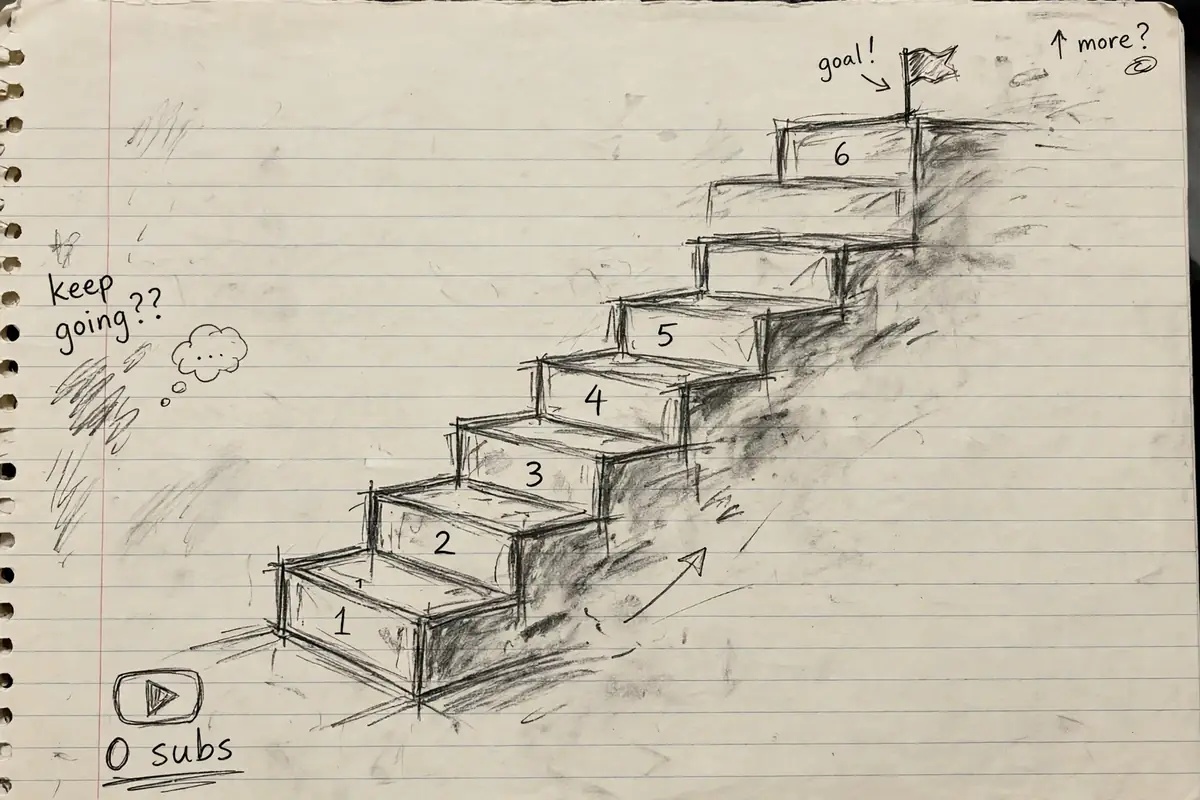
Marcus Jones posted 65 videos in his first year on YouTube and finished that year with 150 subscribers, roughly 15 a month. Then he narrowed his focus to six things, and within six weeks he was gaining about 1,500 subscribers a month.
His argument is that the turnaround had little to do with effort. Success, in his words, comes down to where you allocate your time, and most small channels spread theirs across low-value tasks. If you want to grow a YouTube channel from 0 subscribers, he ranks the six steps below from most to least important. Plenty of people start one hoping it becomes an income stream, the longer game covered in our guide to how to make your first million. Subscribers come first, though.
Step 1: Start with an interesting video idea
Jones puts the idea at the top of his list. A film can have famous actors, a huge budget and great marketing, and it still fails if the plot is dull. A video works the same way. No editor can rescue an idea nobody wants to watch.
He defines a video idea as two parts combined. The topic is what the video is about: a video on tying your shoe has shoe-tying as its topic. The format is how it is presented. Describe that video without naming the topic and you get its format: a tutorial, a compilation, a challenge.
An idea fails in three main ways. It can be plain boring, with nothing new or extreme enough to deserve attention, like a video about what he ate for lunch. It can be late, because interest fades: covering a game update on release day is a different video from covering it six months later, when everyone already knows it. Or it can fall on the wrong side of supply and demand. A dead game has no demand. A Minecraft Let’s Play has enormous demand, but supply is so large that a new channel gets nothing without something genuinely different. Sellers hit the same wall on marketplaces: see how Amazon makes money for the platform’s side of it.
Approaching one person to get over a fear of rejection has been filmed many times. A compilation of approaching 100 people is far more clickable. “The world’s largest explosion” beats “a big explosion.”
Step 2: Make your title and thumbnail work as a team
If nobody clicks, nobody watches, and retention never gets a chance to matter. Many small creators blame the algorithm for not sharing their videos, but YouTube Analytics tells a different story. Under the Reach tab you can see your impressions. Plenty of channels get impressions but few clicks, because the packaging is weak.
Packaging means the title and thumbnail together, and his first rule is that they should collaborate instead of repeating each other. If your title says “funny moments” and your thumbnail also says “funny moments,” you have wasted half your space. On his gaming channel, the title carried the label while the thumbnail showed a funny screenshot from the video itself.
His second rule is to think about the story inside the image. One of his best-performing thumbnails showed Obi-Wan killing Anakin, his own apprentice. The image was grainy and broke several design rules, but it worked because of what it meant. Obi-Wan killing a stranger would have carried no tension at all. Viewers read meaning into a thumbnail, so design for the meaning. Jones ranks packaging above good content for getting the view in the first place.
Step 3: Make videos people actually finish
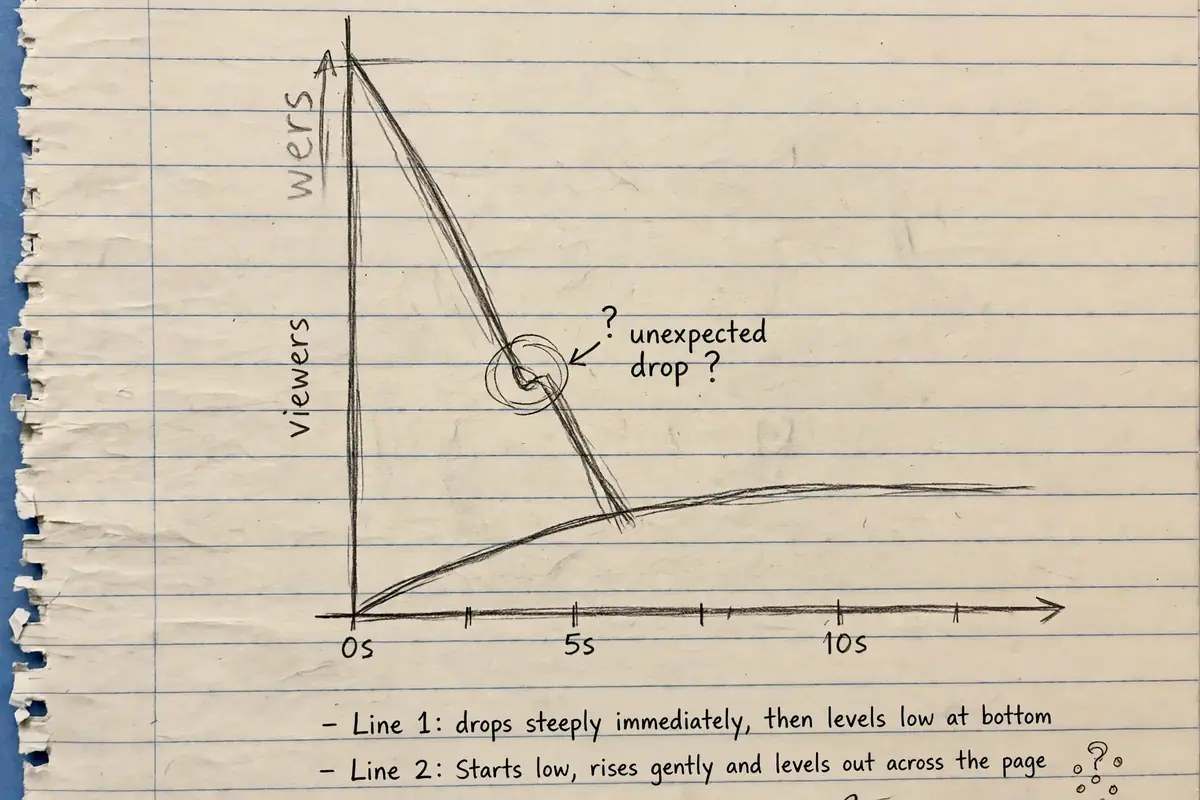
“Make better videos” is the advice everyone gives and nobody explains. Jones defines good content in one measurable way: content that retains viewers. In YouTube Studio, a video’s analytics show the audience retention graph, a blue line tracking how long people keep watching. A line that levels out means the video is holding them. Top channels such as MrBeast keep up to 80 percent of viewers through a whole video.
He breaks retention down into three problems:
Keep viewers stimulated
A video has to hold attention the whole way through. That can mean fast editing, sound effects and jokes, but it does not have to. A calm video can hold people with a relatable topic or a story they want to hear the end of.
Remove friction points
Sometimes the graph looks fine except for one sharp dip where a chunk of viewers leaves within seconds. Jones found a spot in one of his own videos, around the 2:14 mark, where he lost about 2 percent of his audience in 15 seconds. Viewers leave when he says the word “money” or talks about investing. One of his students, an anime creator, lost viewers every time his face appeared on screen. Moving the face cam out of the early part of the video raised his retention by 10 to 20 percent.
Leave viewers satisfied
The third failure is a video people watch to the end and then regret watching. Clickbait that never pays off is the obvious version. It is harder to spot in the graph, though dislikes, negative comments, and decent views with no new subscribers are all clues.
Step 4: Consistency is a separate job from posting often
Consistency gets confused with frequency, and Jones treats them as different things. Posting a lot is frequency. Consistency is keeping your tone, branding, production style, values and topics recognisably the same, so viewers know what they are getting.
He tells the story of a creator he used to watch religiously: relatable, dry British humour, videos with his family, unusual games. Then the creator changed. The relatability went, the humour changed, the family and the odd games disappeared. Jones drifted away, because he no longer knew what he would get.
His test before making a video: am I certain this video will attract the kind of person who would want to watch all my other recent videos? If not, it is probably off-brand.
That does not mean never experimenting. He experimented plenty in his first year, across about 15 types of videos. His method is to experiment in blocks: work one type of content consistently for four to eight videos, and if it still is not working, switch and give the next type the same fair run. When a block clicks, stay with it. That, he says, is what took him from 15 subscribers a month to 1,500.
Step 5: Know your X factors
An X factor is the blend of traits that gives a viewer a reason to pick you over a competitor. Jones asks you to think of your favourite creator and list why you watch them. His example is Alex Hormozi: he sells no course, so the information feels unfiltered, and he talks about life and psychology alongside business.
On his gaming channel, Jones started from the value he wanted to give: humour. Then he pushed it further than anyone around him. He aimed for the highest laugh rate per minute in his niche, invented his own memes from clips nobody else was using, and leaned into being Australian, slang and all, because British and American viewers found it novel. He picked traits viewers would care about and exaggerated them on purpose.
X factors will not bring you many views by themselves. What they do is convert. When the other steps bring a viewer to your channel, your X factors are why that person stays and subscribes.
Step 6: Post often enough to get your practice in
The last step is volume, and he supports it with a story from the book Art and Fear. A pottery teacher split her class in two. One group was graded on making a single perfect pot. The other was graded on making as many pots as possible. At the end of the semester, the best pot in the class came from the quantity group.
Quality on YouTube works the same way, because every upload is practice at thumbnails, editing and talking to camera. Each video is also another chance to be discovered. One video a month gives you 12 chances a year. Two a week gives you 104.
His minimums:
- Long-form: one to two videos a week, and never less than one every two weeks.
- Shorts: at least three a week, daily if you can manage it.
What if your format is slow to make? An animation creator told him each video took one to two months, six chances a year. Jones suggested widening what counts as a video: behind-the-scenes pieces, tutorials on the techniques, timed animation challenges that cannot sprawl. Stay true to the vision, he says, but stay flexible about how it plays out.
How many videos does it take to get 1,000 subscribers?
Jones answers this one with data rather than a pep talk. He studied more than 4,470 YouTube channels that had reached 1,000 subscribers, looking mainly at channels posting long-form videos. On average, those channels had published 77 long-form videos by the time they hit 1,000 subscribers.
Treat 77 as an average, not a deadline. Some channels get there much faster, and plenty take longer. If you have posted nine videos and feel like quitting, you are not failing. You are early in the stretch where most channels are still practising. The first 1,000 subscribers matter beyond bragging rights, too, since 1,000 is the subscriber threshold a channel needs for monetization.
This article is educational content based on one creator’s method and the results he reports. Growth varies widely by niche, topic demand and effort, and nothing here promises subscribers, views or income.