After I organized my kitchen in a weekend, something kept bugging me: why did it take me a year to start a job that took two days? Digging into that question sent me down a rabbit hole — and almost every genuinely useful answer came from the same place: the ADHD community. People with ADHD have spent years figuring out how to organize a home when your brain refuses to cooperate with “just put it away.” Their systems are built around one ruthless principle: fewer steps, always.
Here’s the part that convinced me to write this: those systems work brilliantly even if you don’t have ADHD. Clutter itself makes everyone distracted and overwhelmed — so organizing methods designed for distracted, overwhelmed brains end up being the easiest systems for any brain. I’ve pulled together the approach into four pillars and fourteen practical moves, with the reasoning behind each one.
A quick note before we start: I’m a home & product blogger, not a doctor. This is home-organization advice, not medical advice. If focus and overwhelm are seriously affecting your life, organizations like CHADD and ADDitude are good starting points, and a qualified professional is the right person to talk to.
The core idea: friction is the enemy
Every organizing system fails at the same spot: the moment putting something away takes more effort than putting it down. Open a cabinet, lift a lid, unstack a bin, walk to another room — each step is friction, and friction is where tidiness goes to die. The ADHD-friendly approach flips the usual advice on its head: instead of training yourself to follow a complicated system, you redesign the system until it’s almost impossible to fail.
Everything below is that one idea, applied room by room.
Pillar 1: Design around what you already do
1. Let your piles tell you where storage belongs
That pile on the kitchen counter? It’s data. You pile things where you naturally put them down — so instead of fighting the pile, put storage exactly there. A basket on the counter where the pile forms. A hook where the jacket lands. A tray where the keys get dropped. You’ll organize more in an afternoon of “reading your piles” than in a month of forcing new habits.
2. Put a bin where the mess actually happens
If wrappers collect beside the sofa, that’s where a small bin goes — not in the kitchen two rooms away. Clothes on the bedroom chair? The hamper’s new home is next to that chair. It can feel like giving up (“shouldn’t I just walk to the bin?”), but it’s the opposite: it’s designing a home that works with your real behavior instead of an imaginary version of you.
3. Build a launch pad at the door
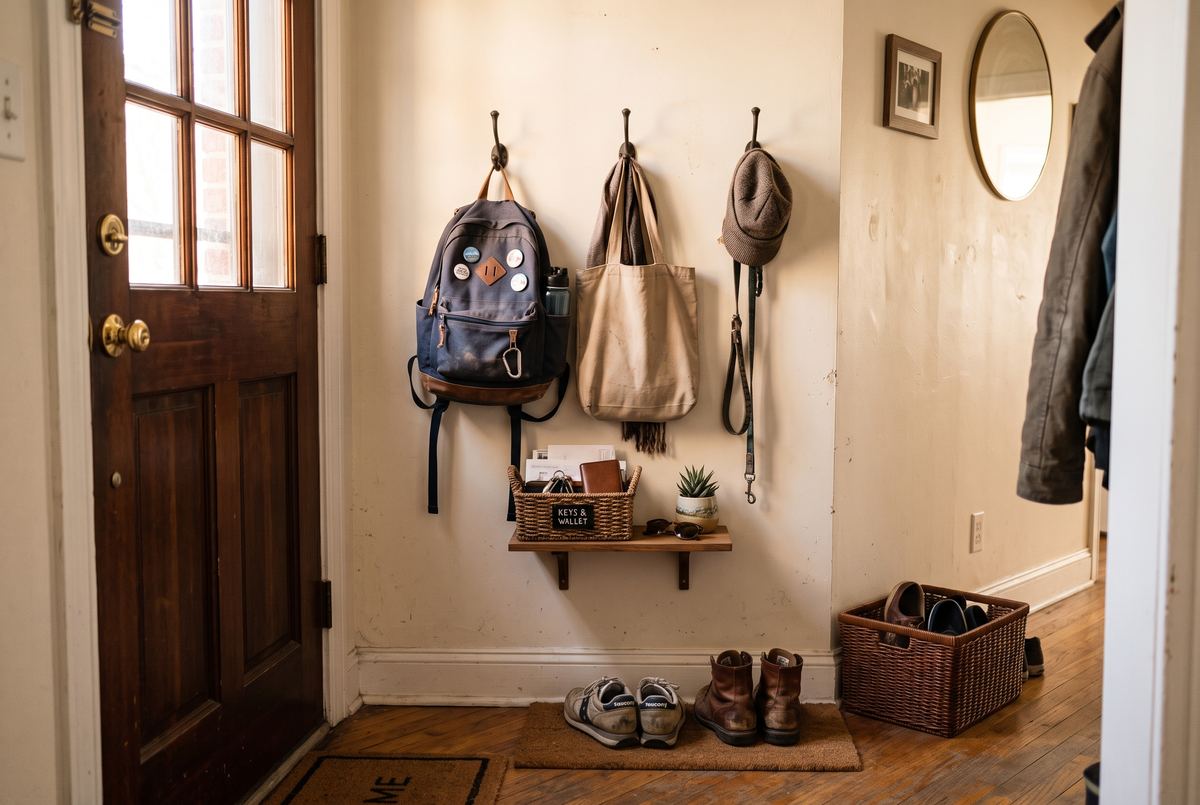
The entryway deserves more attention than any other two square meters of your home. A few hooks, a shelf, a labeled basket for keys and wallet, a spot for the bag you take every day — that’s a “launch pad,” and it solves two problems at once: the morning scramble on the way out, and the clutter avalanche on the way in. Stock it with whatever you always go back for — chargers, sunglasses, even spare socks if that’s your thing. If it leaves the house with you, it lives at the door.
Pillar 2: Make putting away a one-step action
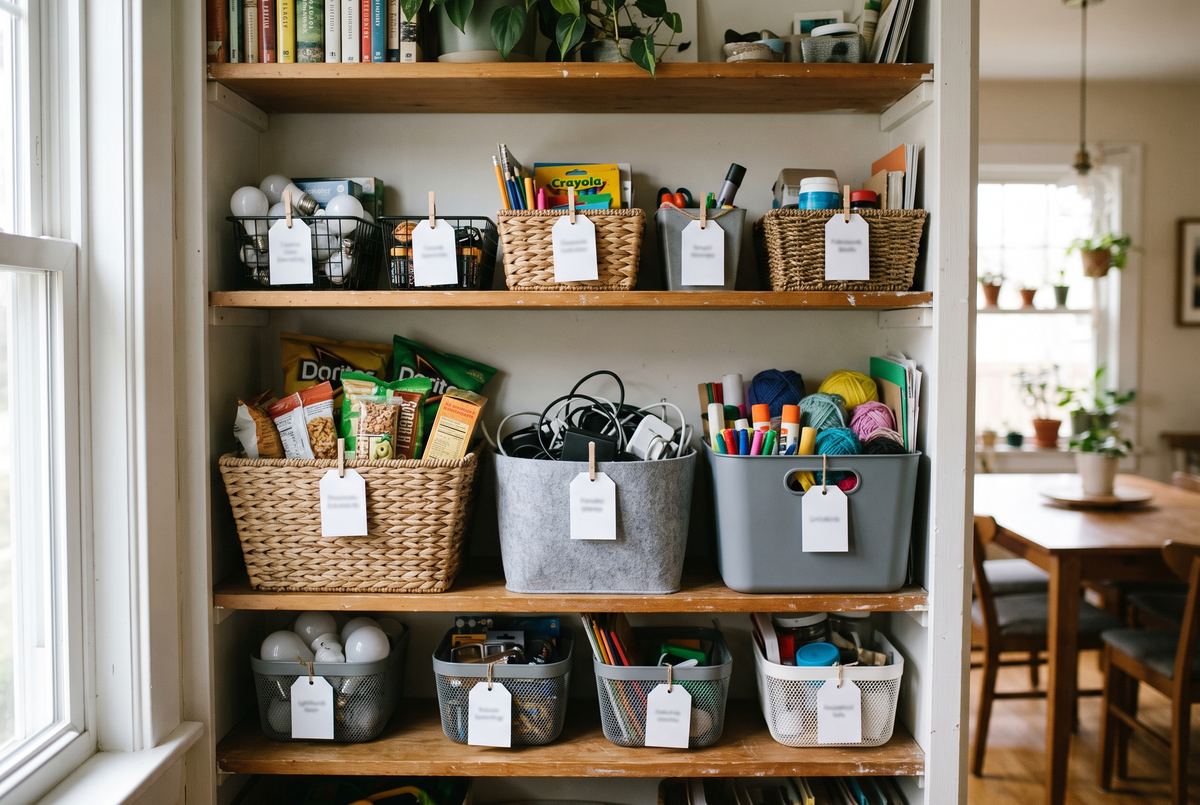
4. Zone your home by activity
Give every activity one place, and keep categories from bleeding into each other: snacks live in one cabinet zone, paperwork lives at the desk, crafts live in their own basket — and laundry never visits the office. Mixed-up spaces are visually noisy, and visual noise is exactly what makes an overwhelmed brain shut down. Zones make a room readable at a glance.
5. Sort into big, dumb categories
Perfectionist organizing — alphabetized spices, color-coded bookshelves — looks great on Instagram and collapses in a week. Broad categories survive: one bin for all cables, one basket for all snacks, one shelf for all books. If a five-second decision can’t place the item, the category is too narrow.
6. Ditch the lids (mostly)
A lid is one extra step, and one extra step is all it takes for things to get set on top of the container instead of inside it. Open-top bins and baskets win for anything you touch weekly. Save lids for two cases only: long-term storage (holiday decorations) and food that goes stale. Everything else stays open, grab-and-drop.
7. Don’t stack anything you use often
Stacked bins are a booby trap — the thing you need is always in the bottom one. If you use it regularly, it needs to be reachable in one motion: front-facing, single layer, no excavation required.
8. Use a go-back basket
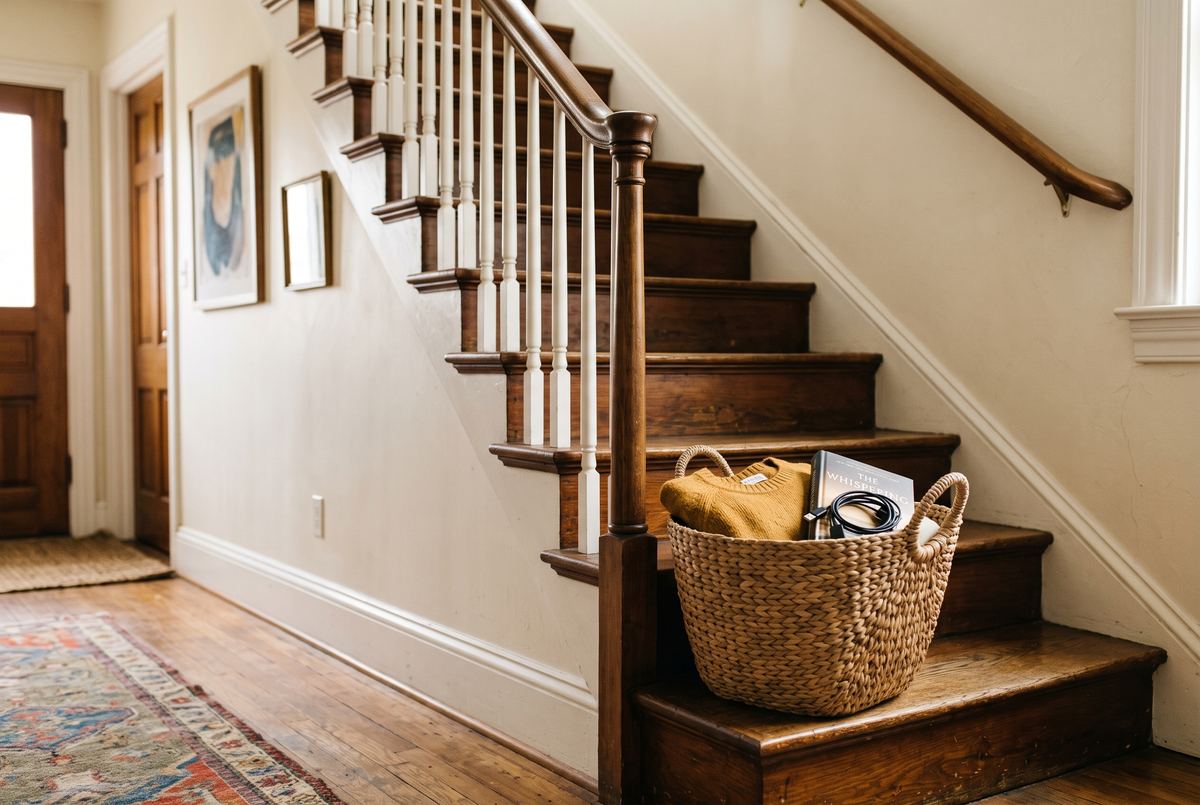
Things migrate around a home, and walking one cup upstairs every time is a losing game. Instead: one basket at the bottom of the stairs for things that belong upstairs, one at the top for things headed down (single-floor homes: one basket per room cluster). Toss items in as you pass, and empty the basket once a day in a single trip. It’s the difference between twenty annoying micro-chores and one two-minute chore.
9. Label everything — yes, even the obvious stuff
A label isn’t decoration; it’s a little instruction that removes the “where does this go?” decision entirely — for you, and for everyone else in the house (no more “where do the batteries live?”). Masking tape and a marker work fine on day one. If the label ever feels unnecessary, that’s the sign the system finally became automatic — leave it anyway.
Pillar 3: Make it visual
10. The three-container paper system
Filing cabinets fail because filing is a multi-step chore you’ll postpone forever. You only need three homes for paper: an action tray (bills to pay, forms to sign), a reference basket (things to read someday), and one big archive box for the year — every dealt-with paper just gets dropped in. No folders, no categories. Come tax season, everything is in one box, already in rough date order because you added it chronologically. Paper handled, one day a year.
11. Use color as a shortcut
Brains process color faster than text. Two sticky-note colors — one for urgent, one for someday — turn a chaotic desk into a readable one. A couple of colored folders (money, home, health) do the same for documents. Don’t build a rainbow system; two or three colors with obvious meanings is the sweet spot.
Pillar 4: Borrow some executive function
12. Race a timer
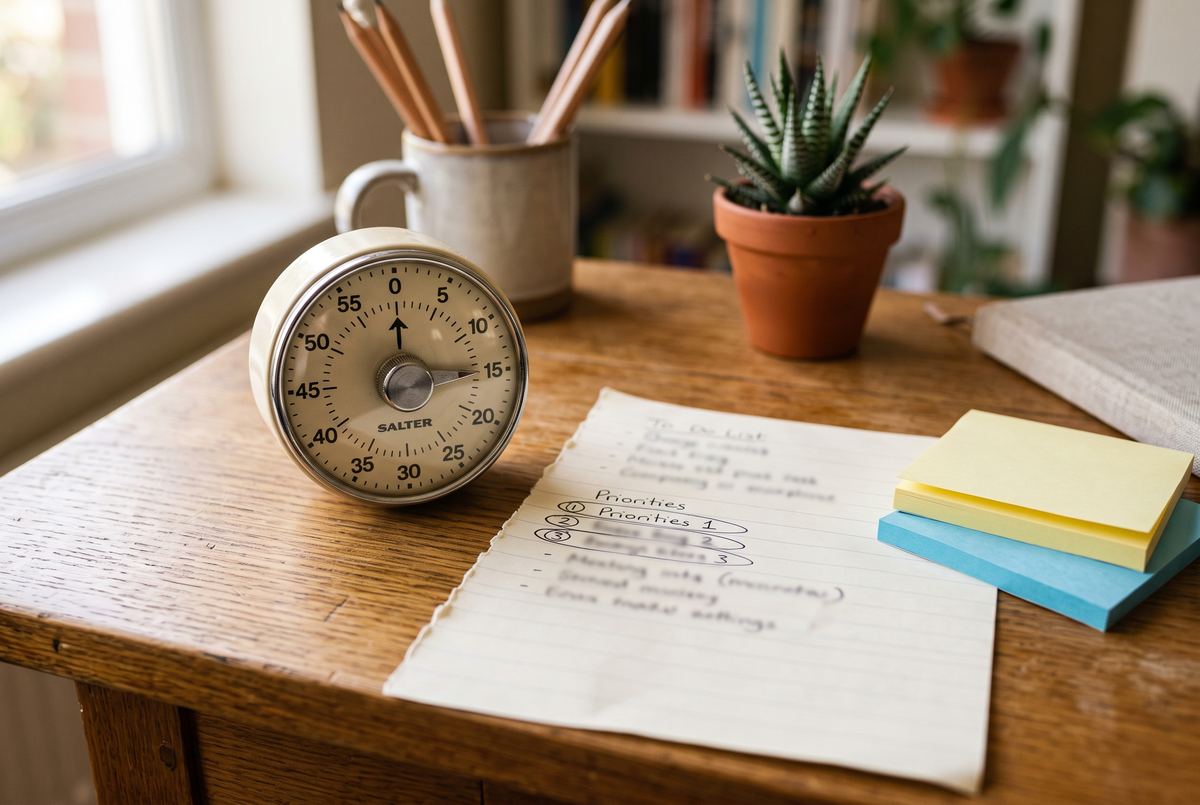
Deadlines create focus that intentions never will — that’s why you can clean the whole house in the 15 minutes before guests arrive. Manufacture that pressure: set a timer for 10 minutes and race it. A physical kitchen timer beats the phone here (the phone is a distraction slot machine), and short timed bursts — the Pomodoro approach — also fix the classic trap of wildly misjudging how long chores take. Tidying for 10 focused minutes daily beats a four-hour marathon you keep postponing.
13. Brain-dump first, then pick three
When everything feels urgent, nothing gets done. Empty the whole mental to-do list onto paper — every nagging task, no editing — then circle exactly three for today. The dump quiets the background noise; the circle of three makes the day winnable. It’s the cheapest productivity system in existence and it works better than most apps.
14. Put your reminders on the outside
Willpower and memory are unreliable narrators; outsource them. Recurring phone alarms for the boring essentials (bins out Tuesday, bills Friday), calendar appointments with yourself for bigger jobs, a smart speaker in whatever room you think of things (“remind me at 6 to move the laundry”). One more trick from the ADHD playbook worth stealing: body doubling — tidying while a friend is on a video call, or just while someone else is in the room, makes tedious tasks dramatically easier to start. External structure isn’t cheating; it’s engineering.
Where to start (without overwhelming yourself)
Don’t attempt all fourteen this weekend — that’s how organizing projects die. My suggestion, based on impact-per-effort:
- Today: put a bin, hook, or basket wherever your worst pile forms (#1–2).
- This week: build the launch pad (#3) and do a 10-minute timer race each evening (#12).
- This month: zone one room at a time (#4–7), labeling as you go (#9).
The goal isn’t a photogenic house. It’s a house where putting something away is so easy you might as well do it. That’s the entire trick.
FAQ
Do these tips only help people with ADHD?
No — they’re simply the lowest-effort organizing systems that exist, which is why they were born in the ADHD community. Stress and overwhelm affect focus in similar ways, so friction-free systems help almost everyone. If you suspect ADHD specifically, talk to a healthcare professional; a tidy hallway is great, but it isn’t a diagnosis or treatment.
What should I buy to get started?
Almost nothing at first. Start with what you own: any basket can be a go-back basket, masking tape makes labels, your phone has the timer. Once the systems stick, upgrade the pain points — open bins for zones, hooks for the entryway, a visual timer if the phone distracts you.
How long until it stops feeling like effort?
Shorter than you’d think — small daily repetitions (the nightly go-back-basket run, the 10-minute race) tend to become automatic within a few weeks. The systems do the remembering, so there’s less to willpower your way through with each passing week.
If you found this useful, the weekend kitchen overhaul is the natural companion read — and more home systems live in Home & Kitchen.