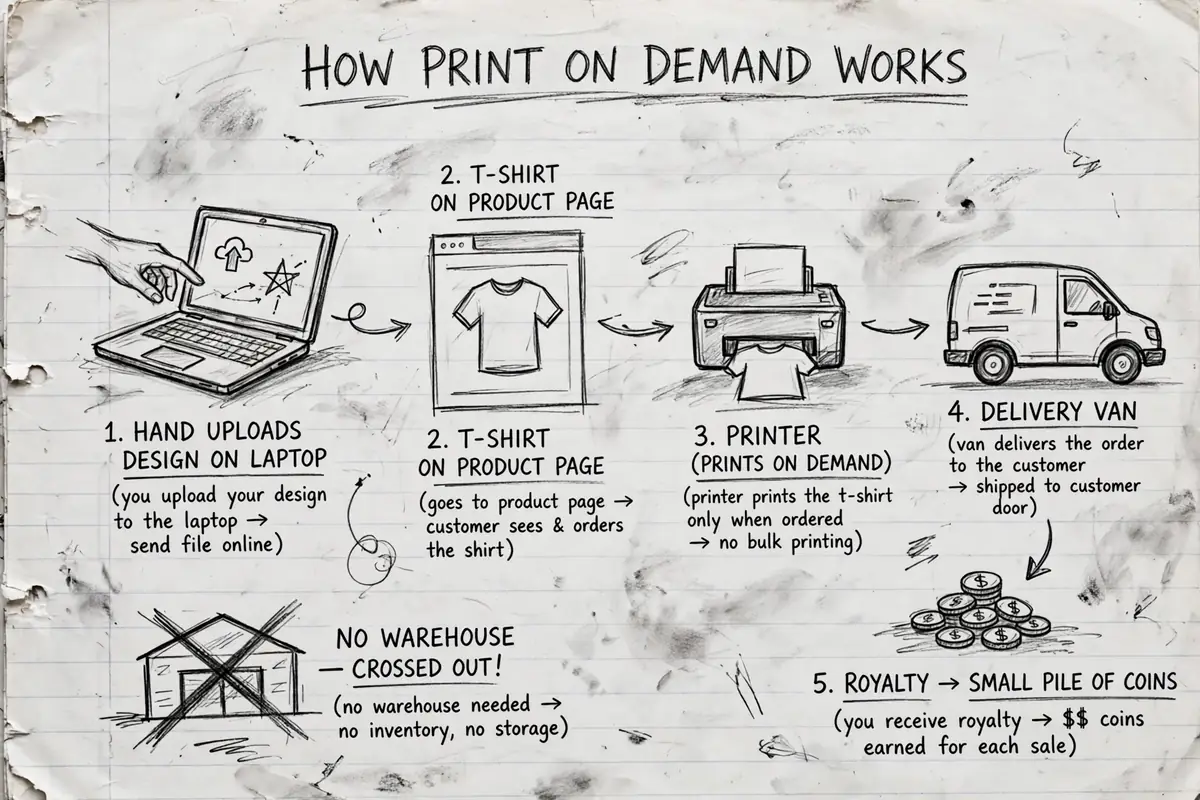
Print on demand is a way to sell products with your designs on them without printing anything yourself. You upload a design to a specialist site. A customer somewhere in the world buys a shirt, mug or poster carrying that design. Only then is the item printed, packed and posted, by a company you have never met. What is left of the customer’s money, after the costs come out, lands with you as a royalty.
There is no stock sitting in your garage. There is no printer humming in the corner. Sellers who explain this model to family often give up and call themselves printers, which is the one thing they are not: somebody else does the printing for them. Your part of the work happens at the start, and this post walks through the whole chain in the order it happens.
What you upload in the first place
A design can be an image, a piece of text, or a photograph. Plenty of sellers work with text alone: short quips, slogans and quotes arranged on a shirt. You do not need to be an artist for that route. Some sellers buy graphics from design marketplaces such as Creative Fabrica, adjust them, pair them with a slogan and upload the result.
Photographs come with one condition. The file has to be sharp and high resolution, because a design can end up printed far bigger than it looks on your screen. A casual snapshot that seems fine on a phone can turn fuzzy when it is stretched across a duvet cover or a large piece of wall art.
Where the design goes on sale
The upload goes to a print on demand platform. Redbubble is the example used throughout this post, and the same shelf holds Merch by Amazon, Spreadshirt, Society6, TeePublic, Spring and Threadless. Books work in a similar way through Amazon KDP, which prints a paperback only when somebody orders it.
Amazon turns up on both sides of this business, as a marketplace and as a print partner. If you want the wider picture of how that company collects money from so many directions at once, our breakdown of how Amazon makes money covers it.
What happens when a customer buys
From your side, almost nothing. The order arrives at the platform, and fulfilment starts on its own. You do not approve the order, buy a blank shirt, or print anything. Some sites send you a notification that you made a sale. Others stay silent, and you find out when you check your dashboard.
The platform sends the order to a fulfilment centre near the customer. Say you live in Inverness, in Scotland, and your buyer is in Belgium. The shirt is printed in Belgium, or in a nearby country such as France, and posted straight to the buyer from there. It never travels to you first, which is why orders tend to arrive faster than people expect.
How do print on demand royalties work?
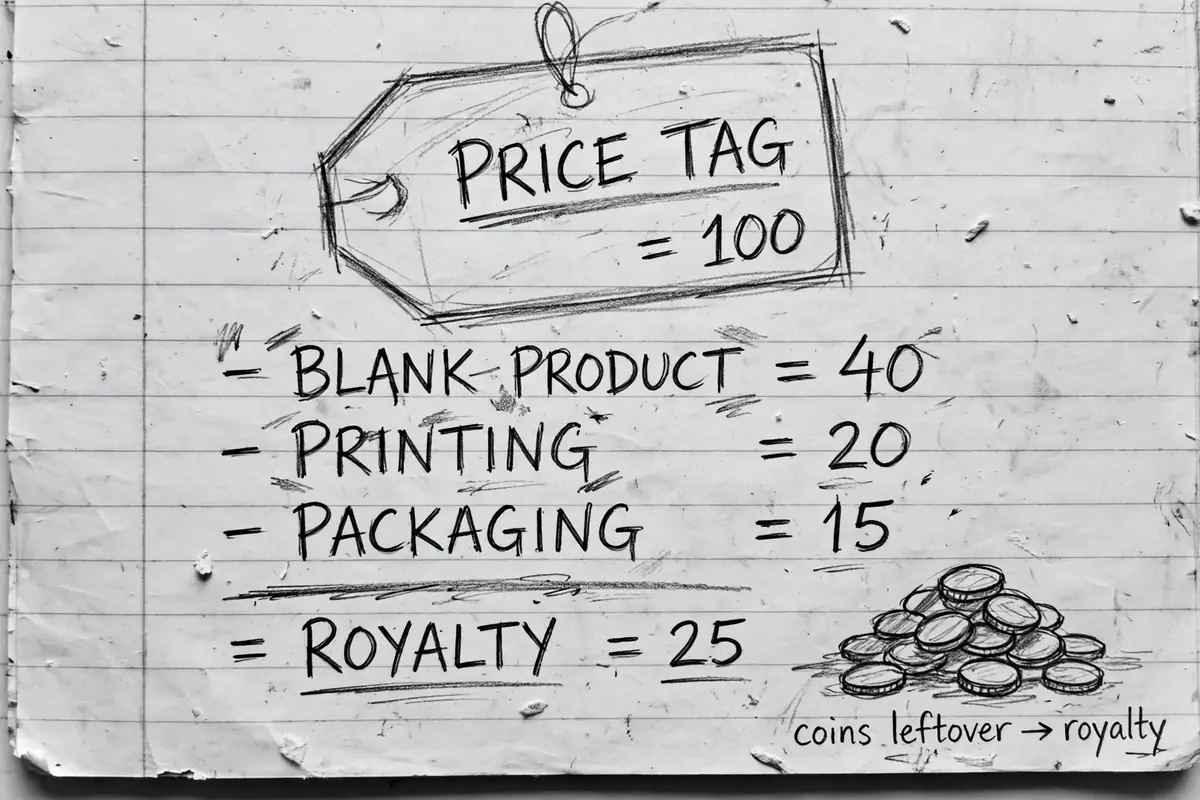
You keep what remains of the sale price after the costs are taken out. The costs are the blank product itself, the printing or embroidery, and the packaging. Everything left over is your royalty, and that royalty is the entire income from a platform sale.
This is also why print on demand behaves like the wider pattern in our guide to making your first million: the money comes from owning something that keeps selling, in this case a design file, rather than from hours you swap one at a time. A design uploaded once can still be earning years later.
Getting people to see your products
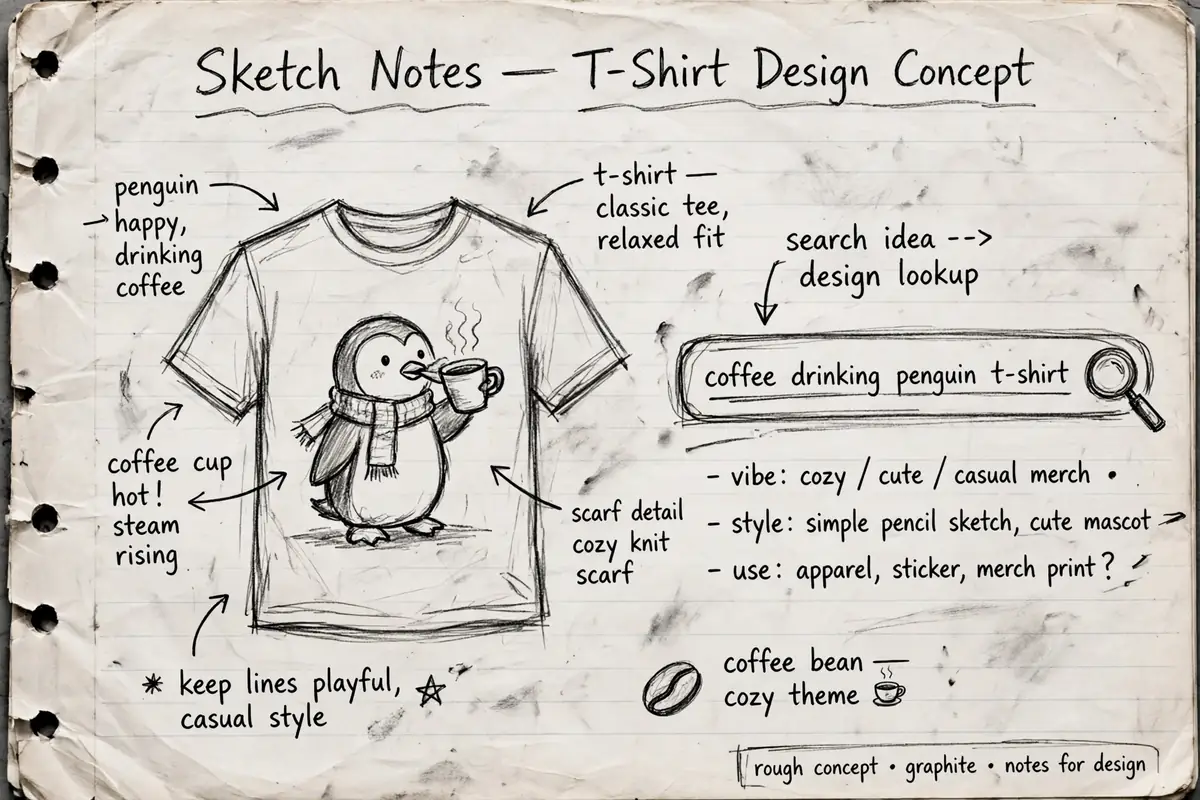
A marketplace listing has to be findable. Buyers type plain descriptions into the search box, so your titles should use the same plain words. A shirt showing a penguin with a coffee needs a title along the lines of “penguin drinking coffee t-shirt”, because that is what the person hunting for a present will actually type.
Narrow niches help here. Search a big marketplace for a microphone stand and thousands of near-identical results appear. A tightly defined niche, coffee drinking penguins rather than animals in general, puts you in a smaller pool. Platforms also push products that already sell toward the top of the results, which makes the early sales the hardest to win. Sellers bring in outside traffic as well, through social media posts, influencers wearing the product, or paid ads on Facebook and Amazon.
Platforms or your own store
The second route is an integration: a fulfilment company such as Printful or Printify connected to your own shop on Shopify, Wix or WordPress, or to a marketplace store on Etsy or eBay. The printing side works the same way. Almost everything around it changes.
What you gain with your own store
There is no competing shelf. A visitor sees your designs and nothing else, so a shopper who passes on the penguin shirt might leave with a matching mug and hoodie instead. Money can work out better as well, because you set the full retail price instead of accepting whatever royalty a platform offers. The customers are yours, too. You hold their email addresses, which means you can write to them at Christmas with a discount code or when a new design lands. Platforms never hand you that information.
The money trap nobody warns beginners about
With an integration, the customer pays you the full price, and the fulfilment company charges you its costs straight away. Price a shirt at $12.99 while your fulfilment cost is $14.50 and you have paid $1.51 for the privilege of making a sale. Platforms carry a safety net here, since a royalty can shrink but cannot go negative. Your own store has no such net.
Timing makes it tighter. Card payments through gateways like Stripe or PayPal can take around five days, sometimes a week, to reach a new seller, while the fulfilment charge leaves immediately. Gateway fees come out of the same money. One order is a nuisance. A design that suddenly sells a thousand copies becomes a cash flow problem, at least until the payouts catch up.
Who deals with the customer when something goes wrong
On a platform, the platform does. Buyers cannot contact you, because the site never shares their details with you, or yours with them. Redbubble might tell you the buyer’s state or country, occasionally a city, and that is all. Refunds and replacements follow the platform’s own policies: a shirt with the neck sewn shut, a print that came out badly, a parcel that never arrived. The big platforms print in serious volume and, in practice, sort these problems out quickly.
On your own store, or on Etsy and eBay, the questions come to you. Write your policies down before the first complaint arrives, and apply them the same way to everyone. Faults are yours to fix. A buyer who ordered pink and wishes they had chosen blue is a judgement call, and whatever you decide for one person becomes the rule for the next.
The part that keeps sellers hooked
The work sits at the beginning: the design, the listing, the keywords. After that, an order can travel from a stranger’s screen to their door without touching your day. Sellers who have done this for years still collect royalties on designs they uploaded a decade ago. That slow, unglamorous drip is the real shape of print on demand, and it is why the model survives every wave of hype around it.
Disclaimer: This article is educational content about how print on demand works. It is not financial advice, and it does not promise any income or result. Earnings vary widely and depend on your designs, your niche and the work you put in.